
What is Agentic Commerce? (and why you should start to prepare now)
Agentic commerce is when AI systems buy things on behalf of users. Not browsing. Not recommending. Actually completing purchases.
An AI agent acts as your shopping assistant - you tell it what you need, and it handles discovery, evaluation, comparison, and the transaction itself (with your permission of course). The entire purchase happens through conversation with an AI, not through clicking around ecommerce websites. That's so 2025.
If you sell anything online, you need to understand how this works and why it matters. I find it fascinating because it feels a lot like the early days of ecommerce SEO, and it will be one of the main topics of this blog.
Commerce Mediated by AI Agents
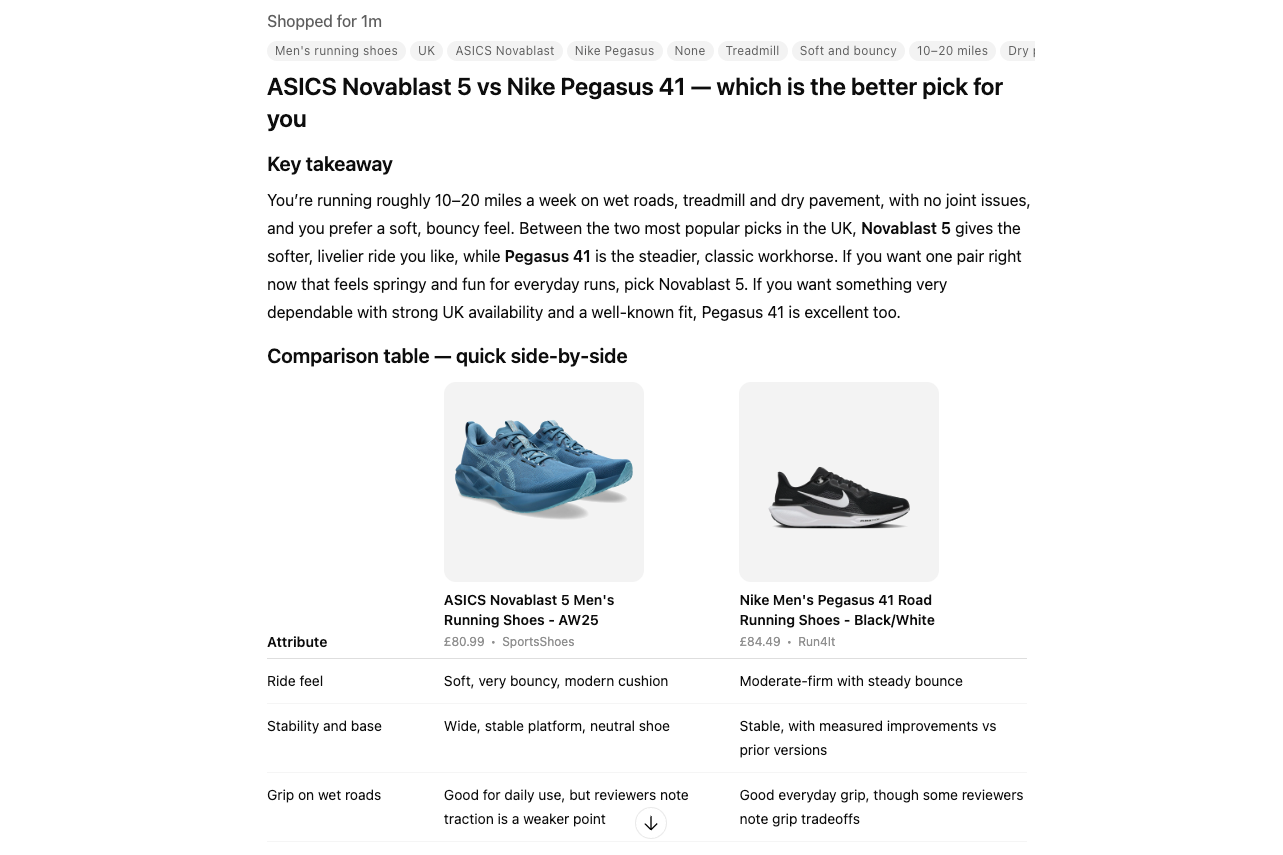
Let's say you share interest in a product ("men's running shoes under £100"), the AI agent handles discovery, evaluation, comparison, and sometimes the transaction itself.
This isn't a chatbot helping you navigate a website either. It's the AI making decisions about which products to surface, how to evaluate them, and with permission, which one to buy on your behalf.
The distinction matters because it changes who controls the purchase journey. In traditional ecommerce, you browse a website. In marketplaces, you compare sellers within a platform. In agentic commerce, the AI browses for you, across multiple sources, platforms, and retailers simultaneously.
The key point here- The user never sees most of the products that exist. The AI agent filters everything down to a handful of recommendations. That filtering happens before you even know the majority of options that exist.
What AI Agents Actually Do Today
I'm not speculating about the future here either. This behaviour exists now...
ChatGPT's Shopping Capabilities

in the US, OpenAI introduced Instant Checkout in September 2025, allowing ChatGPT users to complete purchases directly within the chat interface. You can ask it to find products, compare options, and buy items from participating retailers without leaving the conversation.
The feature launched with Etsy sellers and is expanding to over a million Shopify merchants, including US brands like Glossier, SKIMS, Spanx, and Vuori. Shopify powers product discovery with real-time data on pricing, inventory, images, and variants - making hundreds of millions of products instantly discoverable in a format GPT understands.
When you ask ChatGPT for product recommendations in Instant Checkout, it now shows a "Buy" button on eligible items. Tap it, confirm your details, and the purchase completes, all within the chat. Shopify merchants remain the merchant of record, processing payments through their existing systems and handling fulfilment, but ChatGPT acts as the user's shopping agent.
That's agentic commerce in its clearest form. The AI agent isn't just recommending a product. It's executing the purchase.
OpenAI built this on the Agentic Commerce Protocol, an open standard developed with Stripe. The protocol handles the communication between ChatGPT, the user, and the merchant's backend systems. Merchants can enable payments with a single line of code if they already use Stripe, or connect through other payment processors using the protocol's delegated payments specification.
The company also launched Shopping Research, a feature that creates detailed buyer's guides based on your queries. Ask for "the quietest cordless vacuum for a small flat" and ChatGPT spends a few minutes researching across the internet, comparing options, and building a personalised guide with specific product recommendations.
Perplexity's Shopping Experience
Perplexity launched its shopping feature in November 2025, positioning it as conversational search that knows your history and learns your preferences. The AI remembers past searches and patterns, so when you ask about a desk lamp today, it finds options that match your previously expressed preferences or purchases.
The most interesting bit for me, is how it presents information. Perplexity doesn't show you a list of retailer websites to visit. It creates product cards with images, pricing, delivery details, and curated reviews explaining why each item fits your particular needs.
For Pro users, Perplexity offers "Buy with Pro" the one-click checkout directly within the platform. The company partnered with PayPal to handle transactions, allowing users to complete purchases without ever leaving the Perplexity interface.
Ask “what’s the best winter jacket if I live in London and take the train into the city?” and Perplexity gets the context. It knows you deal with colder mornings, busy platforms and a damp commute, and it recommends products that fit those exact conditions.
Google's AI Shopping Overhaul
Google has been rebuilding its shopping experience around Gemini models. The company announced major shopping upgrades in November 2025, bringing conversational AI and agentic commerce to Search.
In AI Mode, you can now describe what you're looking for in natural language and get well organised responses with visuals, pricing, reviews, and inventory information. Google plans to introduce "agentic checkout", a feature that lets AI agents buy items automatically from eligible merchants when the price hits your target.
You set a price alert for a specific product. When the price drops to your threshold, Google can complete the purchase on your behalf using your saved payment details and shipping preferences.
Google also launched an AI agent that calls stores to check stock and availability. Ask about a specific toy at nearby shops, and the AI will phone local retailers, confirm inventory, and summarise the responses for you.
Amazon's Rufus Assistant
Amazon launched Rufus, an AI shopping assistant now available to all US customers in the Amazon app and on desktop. It answers product questions, compares items, and makes recommendations based on Amazon's product catalogue and customer reviews.
Ask Rufus "what's the difference between these two coffee machines" and it pulls specifications, highlights key differences, and explains which might suit your needs better based on context from the conversation.
Amazon announced significant upgrades in November 2025. Rufus now has account memory so it remembers your shopping activity and preferences. If you've mentioned you have young children who love sports, Rufus factors that into future recommendations.
The assistant can now handle autonomous purchasing. Tell Rufus to "reorder everything we used to make pumpkin pie last week" and it adds those items to your cart. Set a price target for a product, and Rufus will automatically buy it when the price drops to your threshold.
More than 250 million customers have used Rufus this year. Amazon reports that customers who engage with Rufus are 60% more likely to complete a purchase during that visit. That's one hell of an uplift for Amazon and a win for AI.
The interesting dynamic here is that Rufus only has access to Amazon's catalogue. It's a walled-garden version of agentic commerce, but it demonstrates how retailers are building AI agents to mediate the shopping experience within their own ecosystems.
Shopify's Sidekick
On the merchant side, Shopify's Sidekick helps store owners manage their businesses through natural language. "Show me products with declining sales this month" or "Create a discount code for returning customers."
This isn't customer-facing agentic commerce, but it demonstrates how AI agents are being embedded throughout the commerce stack. Store owners use AI agents to manage operations. Customers use AI agents to find and buy products. The entire infrastructure is shifting towards agent-mediated interactions and this is happening fast.

Payment Infrastructure for AI Agents
It's not just AI and shopping platforms making moves. The world's global payment networks are building infrastructure specifically for agentic commerce.
Visa launched Intelligent Commerce in April 2025, opening its payment network to developers building AI agents. The initiative provides APIs and capabilities that let AI agents securely initiate payments on behalf of consumers.
Visa has been working with over 100 partners globally to test and refine the technology. The company announced in December 2025 that hundreds of secure, agent-initiated transactions have been completed in collaboration with partners across the ecosystem. Early pilots include consumer and B2B purchases executed end-to-end by AI agents.
Mastercard launched Agent Pay in April 2025, explicitly positioning it for autonomous purchasing. The programme introduces Mastercard Agentic Tokens, tokenised credentials that enable AI agents to complete transactions while maintaining security and fraud protection.
By September 2025, Mastercard announced that all US cardholders would be enabled for Agent Pay by the holiday season, with global rollout to follow. The company is working with AI and commerce leaders including Stripe, Google, and Microsoft to make secure agentic transactions accessible at scale.
These aren't pilot programmes or concept demos. Payment networks are building production infrastructure because they see agentic commerce becoming a significant transaction channel. They don't move like this unless the shift is inevitable.
How This Differs from Traditional Ecommerce
Ecommerce is direct. You visit a website, browse products, add items to a cart, and check out. The retailer controls the interface, the product presentation, the merchandising, the entire experience. SEO and paid search get you traffic, but once someone lands on your site, it's your game.
Agentic commerce removes that control. The AI agent sits between the user and your website. It decides whether your product gets mentioned. It interprets your product data, compares it against competitors, and presents options based on its own logic.
You don't control the page layout. You don't control what gets emphasised. You don't even control whether you appear at all.
In ecommerce, optimisation means improving your website for human visitors. In agentic commerce, it means making your products discoverable and preferable to AI systems like Chat GPT, Perplexity and Google AI shopping.

Agentic Commerce Optimisation (ACO)?
Forgive me for adding another abbreviation to the already crowded mix of SEO terminology here! I think the work of tuning your product feed, descriptions, schema, increasing brand signals, brand trust and surfacing positive reviews and sentiment will become important very quickly.
I am calling this Agentic Commerce Optimisation for now. It is a new idea, but it sits in the same space that early ecommerce SEO once did and will probably get mixed up in AEO, GEO, AISEO (whatever you want to call optimising for AI). The differentiation and goal is simple: make your products visible, credible and shoppable to AI.
This Isn't a Marketplace
Marketplaces like Amazon or eBay are a platform where multiple sellers compete. The platform sets the rules, but sellers have (some) control over listings, pricing, and presentation. You can optimise within the marketplace's constraints.
Agentic commerce is different. There's no central platform displaying your products. The AI agent pulls information from wherever it finds it; your website, review sites, product databases, retailer APIs. It constructs its own understanding of your product, often without you knowing.
You're not competing for placement on a marketplace results page. You're competing for inclusion in an AI-generated answer.
The agent doesn't show ten results and let the user choose. It might show three. It might show one. The filtering happens before the user sees anything.
Not Quite Conversational Commerce Either
Conversational commerce usually means chatbots helping users navigate a specific retailer's catalogue. You're on the Nike website, and a chat interface helps you find the right trainers. It's still within Nike's ecosystem.
Agentic commerce is cross-platform. The AI agent isn't loyal to any retailer. It searches across sources and presents options based on the user's needs, not the retailer's inventory or merchandising preferences.
Conversational interfaces can be part of agentic commerce (you do interact through chat), but the underlying behaviour is different. One is a better interface for navigating a single store. The other is a new way of mediating commerce across stores.
What AI Agents Prioritise Right Now
I'll be writing more on this, but based on observable behaviour AI agents seem to value:
Structured product data. Clear specifications, consistent formatting, machine-readable attributes. If your product information is buried in marketing copy or fluff, think again.
Reviews and ratings. Not surprising, but worth noting. AI agents pull heavily from review aggregators and user-generated content. They're not just citing star ratings, they're summarising sentiment and highlighting specific complaints or praise.
Comparative context. Agents love presenting trade-offs. "Product A is cheaper but has worse battery life." They need data points that enable comparison across products.
Availability and pricing signals. Real-time stock status and current pricing matter. AI agents don't want to recommend something that's out of stock or mispriced.
Authoritative sources. Links from product databases, manufacturer sites, and established review platforms carry weight. Random blog mentions probably less.
Much like SEO, we don't have full transparency into how these systems actually rank or prioritise products. The algorithms aren't published. We're inferring behaviour from outputs. More on this in later posts (subscribe to get notified when that happens).
The Agentic Commerce Protocol Question
Agentic commerce needs standardised protocols. Structured ways for AI agents and retailers to communicate. Something like schema markup, but purpose-built for agent interactions and purchases.
OpenAI's Agentic Commerce Protocol, built with Stripe, is one attempt at establishing a standard. It's open-source, allowing any merchant or developer to implement it. The protocol specifies how AI agents communicate with merchant backends to complete transactions securely.
Maybe this becomes the standard. Or maybe AI agents will just get better at parsing whatever data they find. Or maybe multiple competing protocols emerge, each optimised for different use cases.
Right now, there's no dominant protocol. Different AI systems handle product data differently. Some use APIs from specific retailers. Some scrape websites. Some rely on third-party product databases.
A standardised protocol could make this cleaner. It could let retailers publish product data in a format AI agents expect, similar to how XML sitemaps help search engines crawl sites efficiently.
But we're not there yet. And it's not clear whether the AI companies want a standard or prefer proprietary approaches that give them competitive advantages.
What We Don't Know Yet
Quite a bit, actually.
Sponsored Placements / Affiliate Links
We don't know how AI agents will handle sponsored placements or affiliate relationships. Will they disclose when a recommendation earns them a commission? How will they balance user intent with commercial incentives?
ChatGPT claims its product results are "organic and unsponsored, ranked purely on relevance." But OpenAI charges merchants a fee for completed purchases through Instant Checkout. That creates financial incentives that might influence behaviour over time.
Trust in AI Shopping
We don't know how much users will trust AI agents to make purchase decisions on their behalf. Early adopters might be comfortable with it. Mainstream users might not be, especially for high-value purchases or products where personal preference matters significantly.
Established or Niche?
We don't know whether agentic commerce will favour large retailers with robust APIs and structured data, or whether smaller merchants can compete by excelling in specific niches that agents learn to prioritise.
Consumer Protection
We don't know if regulation will step in. If AI agents are making purchase recommendations, are they subject to consumer protection laws? Advertising standards? That's uncharted legal territory.
Why This Matters Now
Because the infrastructure is being built while most businesses aren't paying attention.
Payment networks are enabling AI transactions. Retailers are integrating with AI platforms. AI systems are refining their product recommendation logic. Shopify merchants can already sell through ChatGPT. Amazon customers can already ask Rufus to auto-buy products when prices drop.
If you wait until agentic commerce is mainstream, you're already behind. The businesses that figure out ACO (yup I'm sticking to that) early will have an advantage when AI agents become a significant traffic and revenue channel.
Of course, his isn't about abandoning SEO or traditional ecommerce. It's about recognising that a new distribution channel is emerging and learning how it works before your competitors do.
Businesses that understood SEO early captured disproportionate value. Businesses that ignored it struggled to catch up once profitability and budgets were available to early adopters.
I believe, agentic commerce represents a similar inflection point. AI agents are mediating the relationship between consumers and products. The businesses that adapt their product data, their merchandising strategy, and their distribution approach will be the ones AI agents recommend.
This is only the start. I’m going to look at ACO in more detail, with real world observations later. What are the signals that matter? The tactics that actually mean your products are reccommended? The mistakes brands are already making?
But the first step is simple: understand the game you’re about to play.
Because this isn’t coming in the future. It is happening right now, and it is about to rewrite how products get discovered and bought online.