
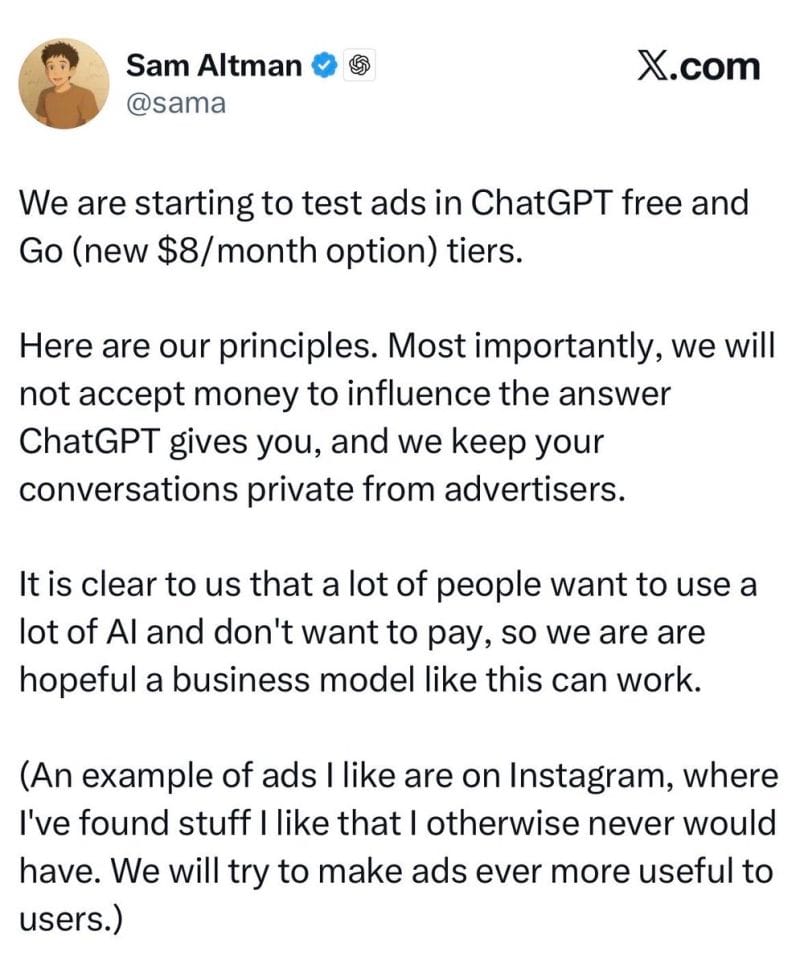
OpenAI recently announced they're testing ads in ChatGPT.
Free and Go tier users ($8 per month) will start seeing sponsored products "at the bottom of answers" when there's something relevant to their conversation in GPT.
Nearly a billion weekly users.
No corporate advertisers yet.
The early window everyone's been waiting for.
Cue the gold rush narrative...
I'm watching SEOs and marketers convince themselves this is Google Ads 2003 all over again. Cheap impressions, massive audience, first-mover advantage before the Fortune 500 CMOs get budget approval and ruin everything.
I think they're half right. There is an opportunity here. But with some caveats.
The real opportunity isn't B2B lead generation at Google 2003 prices. It's consumer products with unprecedented conversational context, combined with early learning that compounds into agentic commerce strategy before your competitors figure it out.
If you're selling enterprise software and dreaming of cheap B2B leads, think again. If you're selling consumer products and willing to learn fast, I believe this could be genuinely transformative.

Why ChatGPT Ads Could Actually Work
Let's start with what's genuinely compelling about advertising in conversational AI interfaces shall we?
Conversational Context Is Unprecedented
Google knows you searched for "running shoes". That's useful.
ChatGPT knows you're training for your first marathon in April, you overpronate slightly, your budget is £150 maximum, and you're worried about knee pain from an old injury you picked up playing football. It knows this because you just spent 15 minutes asking it for training advice.
When an ad appears after that conversation recommending a specific stability shoe with proper cushioning in your price range, that's not keyword targeting. That's requirement matching based on articulated need.
The context is richer than anything display advertising has ever had access to. Google sees intent signals. ChatGPT sees the entire decision-making process unfolding in real time.
The Intent Signal Is Different
Someone Googling "best running shoes" might be researching, browsing, or genuinely ready to buy. You're guessing based on modifiers and search history.
Someone asking ChatGPT "I need running shoes for marathon training, I overpronate, what should I get?" has qualified themselves. They've stated the problem, the use case, the constraint. They're not browsing. They're solving.
That's a warmer lead than almost anything you can target with traditional ads. The signal-to-noise ratio is completely different.
Interactive Ads Change Everything
OpenAI's explicitly planning for ads you can ask questions to. Not static display. Not even dynamic creative. Actual conversation.
"Here's a recommended product" → "Does it come in wide fit?" → "Yes, here are the sizing options" → "What's the return policy?" → "30 days, free returns."
That's not an advertisement. That's a sales conversation happening inside the discovery interface. For products where the buying decision hinges on specific questions (compatibility, specifications, edge cases), this is absurdly valuable.
Small businesses suddenly compete on conversation quality rather than production budget. A £500 monthly ad spend with good conversational creative could outperform a £50,000 display campaign with pretty visuals but no substance.
The Path to Purchase Is Shrinking
ChatGPT already has Instant Checkout integrated. Google's rolling out UCP with direct purchase in AI Mode. The infrastructure for "see recommendation → buy immediately" is being built right now.
Traditional ads send you to a landing page. You browse. Maybe you add to cart. Probably you abandon it. The conversion funnel has 47 drop-off points.
Conversational ads with integrated checkout could go from "here's what you need" to "purchase complete" in about three taps. No site visit. No cart abandonment. No checkout friction.
If the conversion rates are even half decent, the economics could be wild.
Early Mover Advantage Is Real
Low competition means better placement and lower costs. This isn't speculation - it's the mechanics of every new ad platform at launch.
You're not just buying impressions. You're buying:
- Prime placement before it gets expensive
- Time to iterate creative before best practices emerge
- Data about what actually works in conversational interfaces
- Relationships with the platform before they're choosy about advertisers
The businesses that move first build advantages that compound. Not because the window stays open forever, but because the learning transfers to everything that comes after.
The Structural Challenges
Now here's why this may not work for all businesses.
The Free Tier Audience Problem (And When It Doesn't Matter)
ChatGPT Plus users don't see ads. Pro, Business, and Enterprise users don't see ads. Only free and Go tier (£8/month) users see ads.
Here's where it gets interesting.
The knee-jerk reaction is "people who won't pay £20/month for productivity software are price-sensitive and low-value." But that logic breaks down the moment you look at YouTube. Premium users don't see ads either, yet YouTube ads work brilliantly for countless industries.
So what's actually different?
For B2B, the audience self-selection kills you. Decision-makers at companies with budget aren't using free ChatGPT. They're on Enterprise plans specifically because they need the features, compliance, and don't want ads. Your best prospects have opted out before you even start.
This isn't speculation. If you're selling enterprise software, business services, or anything with a complex sales cycle, you're advertising to people who fundamentally aren't your buyers.
For consumer products, it's the YouTube pattern. Someone who won't pay £12/month to remove ads from entertainment isn't revealing much about their purchasing power for other categories. Same applies to ChatGPT's free tier - someone using it casually for recipe ideas or homework help might still buy your £150 trainers or book your holiday rental.
The distinction isn't free users vs paid users. It's where your actual customers are.
Consumer products, impulse purchases, low-consideration items? Free tier could work brilliantly. These users are in-market, they're asking relevant questions, and the conversational context gives you better targeting than YouTube ever could.
B2B, complex sales, premium positioning? You could burn budget on an audience that's already self-selected out of being your customer. The decision-makers you need to reach are in the ad-free tiers.
Attribution Is Broken Before You Start
OpenAI's privacy principles sound lovely. "We keep your conversations private from advertisers." "You can turn off personalisation." "We never sell your data."
Great for users. Nightmare for attribution.
Google and Facebook built advertising empires on cross-session tracking, behavioral data, and probabilistic modeling. OpenAI's launching ads with stricter privacy than Meta had before iOS 14 killed their tracking infrastructure.
You'll likely get last-interaction attribution within the chat interface. Maybe. If you're lucky.
For simple, single-session purchases (impulse buys, low consideration products), that's fine. For complex B2B sales cycles where someone asks ChatGPT a question in January and converts in March? You're flying blind.
Try explaining to your CFO why you're spending £5,000/month on ads with no reliable way to prove they drove the £50,000 deal that closed last quarter.
The measurement problem alone could make B2B advertisers think twice. Let's see how it pans out.

What You Should Actually Do
Set aside budget for ChatGPT ads when they launch.
If you're selling consumer products, you're testing for acquisition. The conversational context is genuinely better than search ads for categories where questions matter. Low competition means better placement. Integrated checkout means higher conversion. This could work.
If you're selling B2B, you're testing purely for learning. The acquisition won't pencil out (wrong audience, broken attribution), but the knowledge compounds. You need to understand how conversational commerce works before everyone else figures it out.
Either way, test to learn:
- How ad creative performs when it appears after AI-generated answers
- Which product categories actually convert in conversational interfaces
- What happens to messaging when someone's 12 exchanges deep in a conversation
- How people respond to sponsored recommendations vs organic suggestions
- Which offers work mid-conversation
This isn't just about ChatGPT ads. The knowledge you gain testing conversational advertising informs your entire agentic commerce optimisation strategy.
When AI agents start making autonomous purchases through protocol integration, you'll already understand how buying decisions work in conversational interfaces. That's the compound advantage.
When ChatGPT Ads Could Work
Specific conditions where this could genuinely drive growth:
Consumer products with clear intent signals - Someone asking for gift recommendations, meal planning, travel advice. The conversational context matches purchase intent better than search keywords ever could. Works.
Impulse purchases and low-consideration items - Lower cost, immediate need, conversational discovery helps. The free tier audience doesn't matter when someone's asking "best wireless earbuds under £40" and you've got the answer. High conversion potential.
Products where questions close sales - Technical specifications, compatibility, edge cases. Interactive ads that answer "will this work with my setup?" convert better than static display. The ability to ask follow-ups is a genuine advantage that traditional ads can't match.
Categories with high browse-to-buy friction - If your traditional conversion funnel loses 80% of people between landing page and checkout, integrated purchasing could fix that. The path compression genuinely matters here.
Learning opportunities regardless of ROI - Even if ads don't scale profitably, the data you gather about conversational commerce behaviour compounds. Worth testing to build knowledge that transfers to agentic commerce strategy.
When ChatGPT Ads Probably Won't Work
B2B and complex enterprise sales - Attribution, free tier users aren't decision-makers, can't track multi-touch journeys, buying committees aren't using free ChatGPT.
High-consideration purchases - Buying a car, choosing a mortgage, selecting enterprise software. People may not make these decisions mid-ChatGPT conversation.
Anything requiring sustained engagement - ChatGPT explicitly doesn't optimise for time spent. If your business model needs people scrolling for 20 minutes building consideration, this isn't your platform. Users are there to get answers and leave.
Where This Actually Matters
As I covered in what is agentic commerce, we're expecting commerce shift from browse-and-click to agent-mediated discovery. ChatGPT introducing ads is surface-level monetisation happening alongside deeper infrastructure changes.
Google's Universal Commerce Protocol and OpenAI's Agentic Commerce Protocol aren't advertising infrastructure. They're commerce infrastructure. When AI agents start making autonomous purchases through protocol integration, the businesses that understand conversational commerce mechanics will have compound advantages.
ChatGPT ads are useful precisely because they force you to think about how commerce works when the interface is conversational rather than visual.
For consumer products, test for acquisition. The opportunity is real.
For B2B, test for learning. The acquisition may not work, but the knowledge transfers.
Either way, the businesses that move early build muscle memory for a commerce paradigm that could potentially displace traditional ecommerce. The question isn't whether to test ChatGPT ads. It's what you're actually testing for.